

In the Footsteps of the Celts
Discover places once inhabited by the Celts.
Among the oldest inhabitants of the Bohemian Forest are undoubtedly the Celts. When they arrived in the region around the 6th century BC, they brought with them the first known name for the area: “Gabréta Hylé”, which meant “Forest of the Ibex”. They established here one of the most extensive Celtic hillforts. Other sites include the highest located hillfort in the country, Obří hrad near Nicov, and Sedlo near Albrechtice.
In late summer 2008, the Union of Municipalities of Věnec, in cooperation with the municipality of Kubova Huť, opened the “Celtic Educational Trail”. This trail is 27 kilometres long, has six stops (Kubova Huť, Boubín, Buk, Mářský vrch, and two in Lčovice), and is marked by yellow-brown arrows. It leads from Kubova Huť through Boubín and Mářský vrch to Věnec.
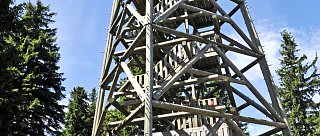
The hike begins in Kubova Huť, known for having the highest railway station in the Czech Republic (995 m above sea level). The mountain passes between Boubín and Obrovec were used by traders long before the railway was built, including Celtic merchants and later salt traders, as one branch of the Golden Trail passed this way. Originally, a glassworks stood here from 1729, named after the forest that belonged to the captain Guba. Today, the locals live mainly from tourism, as Kubova Huť is a popular winter sports centre and in summer a starting point for climbing Boubín’s summit. We’ll head there as well. After a steep climb, we reach the highest point of the hike. At the top (1362 m above sea level) stands a wooden lookout tower built in 2005, offering panoramic views of the entire Bohemian Forest, and in good weather, even the Alps. There is also a memorial stone inscribed “Cardinal Fürst von Schwarzenberg, 3. 8. 1867”, commemorating the visit of the Archbishop of Prague. On the slopes of Boubín lies a famous nature reserve, established in 1858 by forest manager John. The Boubín Virgin Forest covers 666 hectares and is now fenced off and inaccessible.
We descend to Včelná. Notable natives from here include writer Karel Čada and Professor Josef Kříž. Today, at house no. 5 (owned by the Nuska family), you can find the largest private iron museum in Europe. Crossing Cikánský stream, we reach the village of Buk, first mentioned in 1400. On the village green stands the Chapel of Our Lady of Sorrows from 1800 and a heritage-protected farmhouse no. 5.
Next stop is Svatá Maří. The local church of St. Mary Magdalene, originally Gothic, was rebuilt in the Baroque style in the 18th century, but Gothic elements have survived, such as the baptismal font with the coats of arms of the Bukovský, Nebřehovský, and Přech families, and a holy water font. The bells are among the oldest in the area. Near the presbytery with Romanesque foundations grow protected small-leaved lindens, 200 and 350 years old.
Following the red tourist trail past the familiar Mářský vrch and Budilov, we approach a tangible Celtic monument – the hillfort on Věnec. Just after Budilov, we pass the so-called Královácký Stone and recall that the local peasants were directly subject to Queen Eliška, as mentioned in a Latin document dated August 11, 1314. This document lists the villages of the royal district of Volyně, including Bošice (with the forest Brdo) and Budilov.
On the rocky hill Věnec, also called Pržmo (765 m above sea level), lies a protected cultural monument – a hillfort from the Hallstatt and La Tène periods. Artificial earthen ramparts connect to the natural rocky fortifications. The most extensive archaeological survey of the hillfort was conducted by Professor Bedřich Dubský in the 1920s. He found fragments of pottery and a bronze pendant with five rings (likely belonging to a notable person) from the transition between the Hallstatt and La Tène periods (6th–5th century BC). A wedge and a flint knife were also discovered, suggesting the site may have been settled even during the Stone Age. However, findings indicate it was not inhabited in the Slavic period.
From the hillfort, we descend into the lower part of Lčovice village. The loop can be completed by taking the local train from the station back to Kubova Huť.
Basic information:
- Starting point: Kubova Huť
- Route: Kubova Huť – Včelná – Buk – Svatá Maří – Budilov – Věnec – Lčovice – Kubova Huť
- Length: 27 km
- Difficulty: higher
- Access: on foot
- Refreshments: Kubova Huť, Buk, Svatá Maří, Lčovice

