Siamo spiacenti, questo articolo non è disponibile nella lingua scelta. EN abort

The Path of Suffering Stones

A modern Way of the Cross in the forests above Písek highlights the hardships of contemporary life and the world.

Lunghezza totale

3 km

Requisiti di tempo

3 hours

Terreno

Asphalt, gravel, forest paths

Periodo di visita consigliato

Accessible all year round except in severe winter conditions

Esigenza fisica

Moderate difficulty, as the route goes uphill

Descrizione del percorso

This is a circular route. The path ends at the Písek Foresters’ Viewpoint. From there, you can follow the signs to Jarník Lookout Tower and then continue to Živec Lodge, where you can join the route leading back down to Písek.

The starting point is U Vodáka (Písecké hory). The route ascends for about 3 km. The way back can be chosen via different paths.

The physical realization of this unusual concept was the creation of a modern Way of the Cross, which found its place in the landscape of the Písek Forests. It draws from the symbolism of the Christian Stations of the Cross and its message—fourteen sufferings, fourteen stations leading to the summit—the Station of Hope. A key aspect of the initial deliberations was finding the right course for the route, which was ultimately designed by Písek native MVDr. Václav Holý. The trail is 1.5 km long and ascends from the U Vodáka area through the picturesque nature park to the Písek Foresters’ Viewpoint below Jarník Mountain (609 m above sea level).

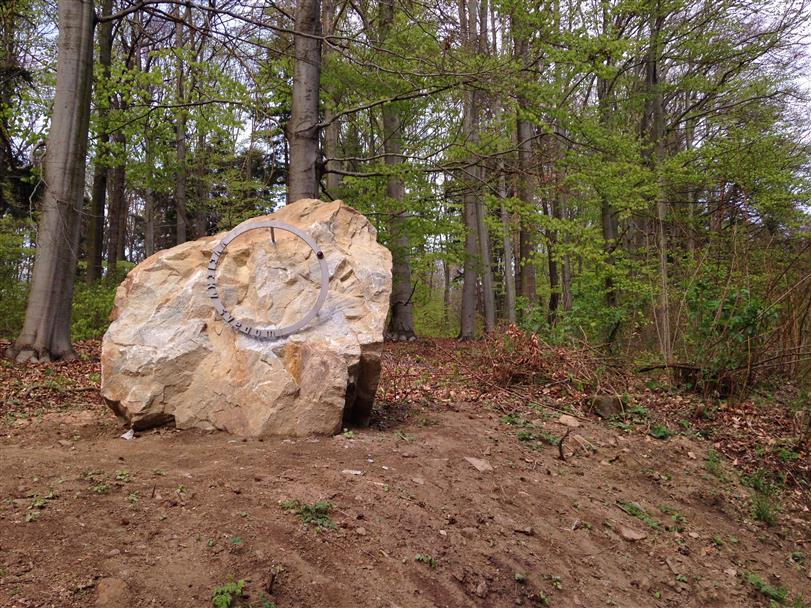
The artistic design of the Path of Suffering Stones was entrusted to architect Laura Jablonská. From the outset, her concept worked with stone as a symbol of burden and weight, emphasizing visually dominant elements, human scale, and the principle of verticality, which transcends the individual. In collaboration with students, uniquely shaped and colored 5–7-ton stones were selected in a Písek quarry and vertically anchored into the terrain using a demanding technique. A unifying artistic element of the path is the circle, symbolizing unity, absoluteness, infinity, and eternity. This principle is present in each of the fourteen sufferings and culminates in the Station of Hope. Each stone is fitted with a metal ring bearing the name of the suffering and a lens of ruby-red glass, symbolizing a drop of blood.

After the fourteenth station, the path ascends steeply through rugged terrain to the Písek Foresters’ Viewpoint. Symbolically, this reflects the difficult journey toward hope, requiring one’s last reserves of strength and willpower. The end of the path thus also represents a new beginning. The Station of Hope is the culmination of the journey—both in a literal and figurative sense. Its design sets it apart from the rest, yet its circular motif ties it to the whole. It is no longer a burden but a promise.

This station is represented by a circular sculpture with a diameter of 2.5 meters, created from massive metal plates arranged in four segments, with their intersections forming a cross-shaped pattern. The center features a disc of frosted glass, allowing light to pass through and illuminating the dark metal surface, symbolizing hope within reach. The metal plates bear the marks of more than a thousand bullet impacts, serving as a symbolic reminder of scars left behind by struggles endured.

With the Station of Hope, the Písek Foresters’ Viewpoint not only offers a magnificent panoramic view but also a meditative space under the open sky, capable of carrying the prayers and gratitude of every visitor.