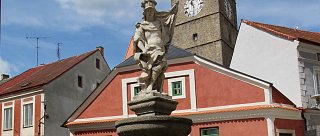


Slavonice – Renaissance Complex of Historical Monuments
Since 1961, Slavonice has been a designated urban conservation area for its preserved Renaissance architecture.
Slavonice boasts a unique collection of historic monuments. In the town center, you’ll find richly decorated houses and structures built in Renaissance, Gothic, and Baroque styles. Also remarkable is the accessible drainage and tunnel system beneath the town.
The origins of the town date back to the 12th century, with the first written mention in 1260. Originally a settlement and later a market village owned by the Lords of Hradec, Slavonice gradually evolved into a fortified town. From the 13th century, an intricate underground system was built for drainage and defense.
The 14th century marked major expansion: a western square (Míru) and an eastern market (Horní) were established. These formed a medieval layout of houses with long plots and narrow yards.
Between the two squares stands the Church of the Assumption of the Virgin Mary with its dominant tower, built 1503–1549 by Master Michal. The current Baroque roof was added after the fire of 1750. The basilica features Gothic and Renaissance elements with chapels added in the Baroque period.
Northern and southern side streets (e.g. Jan Šverma and B. Němcová) formed with small houses. Parts of the city wall and two original gates remain. In the 16th century, the city thrived economically, and the houses on both squares were rebuilt in Renaissance style with sgraffiti and vaulted halls.
After 1600, construction ceased. The Thirty Years’ War, a plague (1680–1681), and a major fire in 1750 caused severe damage. Recovery began at the turn of the 17th and 18th centuries. In 1902, a railway connection to Telč was built. In the late 1950s, monuments were restored, and on August 31, 1961, Slavonice was declared an urban conservation area.

