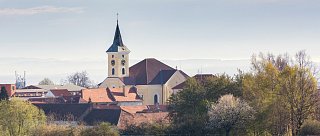


Church of St. Wenceslas in Lišov
The neo-Romanesque church was built between 1862 and 1865 on the site of an older structure, from which it retained the tower aligned with the main façade.
The first written mention of the town of Lišov dates back to 1334. In 1619 the town was burned down, including the parish. Until 1661, when Stanislav Gajecius became the local priest, a priest would only come to Lišov on certain days. Gajecius brought an image of the Virgin Mary to the church, which remains part of the altar to this day. In 1658 the church was fitted with a bell from Nuremberg. Burials around the church continued until 1756. Despite several renovations, the church was declared inadequate in 1861 and was subsequently demolished, except for the aforementioned tower. A year later, the foundation of a new building was laid, and it was consecrated in 1864. The total cost of the construction was 40,000 gulden. In the following year, the church received a new organ from the workshop of František Svítil Sr., a significant Czech organ builder. No other known instrument of his has survived.
The largest bell of the Black Tower in České Budějovice, called "Bumerin," allegedly originated from the church in Lišov. According to legend, the bell originally belonged to the town of Rudolfov but was confiscated during a dispute between local miners and Budějovice. The locals buried the bell to save it, and many years later, it was found by a pig herder on Sviní louka near Lišov and donated to his town. However, the bell was too heavy for the Lišov tower, so it was sold to Budějovice. With the proceeds, Lišov bought three smaller bells and still had money left over.

