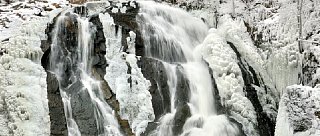

Jordán Waterfall
The Jordán Waterfall is the overflow from the Jordán Pond cascading down a rock massif.
About 1 km downstream of the waterfall, below the Bechyňsk Gate, there is an interesting artificial cascade over 3 meters high.
Jordán is a reservoir in Tábor covering over 51 ha. Created in 1492 by damming the Košínský Stream, it's the oldest reservoir in Czechia. Initially built to supply drinking water, it later served for fish farming as well. However, due to difficulty in draining (last major drawdown in 1830) and complex net fishing (carried out until the mid‑20th century), large-scale fish farming was abandoned. Since then, the reservoir has been used mainly by sport anglers and for recreation. Its earth dam is 20 m high and 284 m long, holding about 3 million m³ of water. The maximum depth is 12.5 m. Water exits via Tismenický Stream, directly below the dam lies the 18 m high Jordán Waterfall. On the Košínský Stream, below the Košín I reservoir, lies a smaller dam called Malý Jordán.
The height of the stepped structure is 12 m, it is multibranched and fan-shaped. Built in Tábor in 1693, it was artificially created at the right end of the dam, farther from the town, to discharge water in case of flooding. The waterfall is part of this overflow and its bedrock is syenite, commonly referred to as “granite bluestone”. It has a distinctive fan shape, with a width of 6–8 meters at the base. At lower flow, it splits from a single sheet into multiple streams. A characteristic feature is a vertical rock pillar protruding on the left side of the cascade.

