

Among Roses and Baroque Around Blatná
Even during World War II, roses grown in Blatná were famous worldwide. Breeder Jan Böhm developed dozens of varieties and distributed them across Europe. This trail leads through the most beautiful spots of this “rose town.”
Total length
9 km
Duration
2:30 h
Terrain
Field paths, asphalt, gravel.
Difficulty level
Easy
Marking
Yes
Route description
The starting point of the walking trail around Blatná is the Marian Column at Míru Square. From there, follow the red and yellow tourist markers along Nad Lomnicí Street, where you can visit the old 19th-century cemetery. Continue on Na Blýskavkách Street, and after approximately 700 m, turn onto Blýskavky Street, which connects to the road linking Blatná and Buzice. Follow cycle route no. 31 to the old execution site with the remains of a 16th-century gallows.
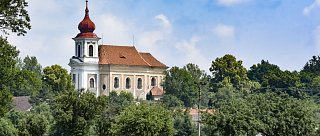
From the execution site, také an unmarked path along Zadní Topič pond leading to the contribution granary from the early 19th century. Continue on the asphalt road, which brings you to the main road toward Prague. Cross the road and follow a field path along Kaneček pond to a lookout point offering a beautiful view of the Baroque Church of St. John the Baptist in Paštiky, which you’ll reach via cycle route no. 311.
From the church, the blue tourist marker leads you on a circular path around Vinice Hill, offering scenic views of Blatná, and toward Pustý pond. At the intersection of Holečkova, Jana Wericha, Sadová, and Palackého streets, leave the blue trail and follow the dam of Pustý pond westward. At the end of the dam, turn into Husovy Sady Park, walking through to Antonín Kalina Square. Here you’ll find two important First Republic buildings — the Sokol Hall and the Böhm Villa.
Continue along Böhmova Street to the ice rink, and along the Závišínský stream and Lomnice creek — the future Rose Trail — until you reach the Church of the Assumption of the Virgin Mary. In Blatná, you can visit many restaurants, cafés, wine bars, a brewery, a distillery, or the castle. For more information, visit the tourist information center at tř. J. P. Koubka 4.
Interesting places on the route
Marian Column
The Marian Column was built in 1726 as a memorial to the plague epidemic that struck Blatná in 1714. It was funded by Count Josef Serényi, the then-owner of the estate, whose coat of arms, along with that of his wife Marie Alžběta Serényi née Valdštejn, is displayed on the column. The design and sculptural work were done by Johann Hoffmann.
Old Cemetery
This 19th-century cemetery is the final resting place of many prominent local figures — renowned Czech rose breeder Jan Böhm, Catholic priest Jan Pavel Hille, and poet Jan Pravoslav Koubek, among others.
Contribution Granary
Dominating the area between the Přední and Zadní Topič ponds, this three-story granary was built before 1837. Architecturally valuable, its unique entrance façade features a central projection with a columned portico and thermal windows. Today, it serves as an exhibition space.
Gallows Remains
The remnants of a gallows from the early 16th century, used for high-profile executions, stand on a gentle hill near what was once an important trade route. The ground plan, formed by rounded stones set into a rectangle, is still visible, as are parts of the execution platform and the audience area. In 2003, a symbolic “knee” gallows was erected here to commemorate the site’s original purpose.
Church of St. John the Baptist in Paštiky
North of Blatná lies the small village of Paštiky, dominated by the Baroque Church of St. John the Baptist. Built at the initiative of Countess Marie Alžběta Serényi née Valdštejn on the site of an older medieval church, construction began in the late 1740s. The original plans by Johann Hoffmann were radically revised after his sudden death in 1747 by one of the most prominent Baroque architects, Kilian Ignaz Dientzenhofer, making this one of his final and most significant works. Dientzenhofer personally oversaw the construction, visiting Paštiky five times. The church’s interior features work by renowned Baroque artists: woodcarver Ferdinand Ublacker crafted the altars, pulpit, confessionals, and organ case, while Prague painter Jan Václav Spitzer handled the painted decorations. The surrounding cemetery includes a chapel, also designed by Dientzenhofer, which has served as the Hildprandt family tomb since 1846.
Sokol Hall
Blatná’s Sokol Hall is one of the most valuable examples of Functionalist architecture in South Bohemia. Designed by notable architect František Průša from Volyně, it was built in 1931–1932 and has been preserved in nearly original condition. All surfaces, doors, windows, furnishings, technical facilities, and even the original ventilation systém remain intact. The building is rightly considered a model textbook of First Republic design, materials, and technical innovations. Sokol Hall is part of the Blatná Urban Monument Zone.
Böhm Villa
Opposite the Sokol Hall on Antonín Kalina Square stands another significant First Republic building. This rondo-cubist villa was designed by architect Jan Komance and built between 1921–1922. Originally intended as a five-unit apartment house, it was soon purchased by world-famous rose breeder Jan Böhm, who established a test rosarium for his rose-growing business in the adjoining garden.
Church of the Assumption of the Virgin Mary in Blatná
The original church dates back to the 13th century, of which only today’s sacristy remains. In the 15th and 16th centuries, under the Lords of Rožmitál, the current church was built, featuring a presbytery with a net vault and a unique two-aisle nave with cell vaulting. Inside, you’ll find many sepulchral monuments, high-quality late Gothic sculptures (such as the Madonna and Child and a Crucifixion), and valuable Baroque furnishings. It is one of the few monuments in the Czech Republic preserved almost entirely in its original form, without significant later alterations. This is also true for the entire parish complex, which includes the deanery, the chapel of St. Michael the Archangel, a Baroque cloister, and a bell tower.

