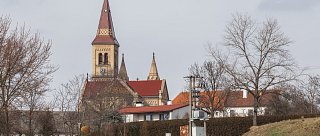

Church of Saints Peter and Paul
The original church of Saints Peter and Paul was built in the Romanesque style between the second half of the 11th century and the end of the following century.
Due to insufficient capacity, a new early Gothic church was built in the 13th century. Further major modifications to the church in Hosín occurred during the Baroque period, when, among other changes, a choir loft was installed opposite the presbytery to facilitate liturgical music.
The large attendance of worshippers, not only from the Hosín parish itself but also from other places, at local church festivals in the late 19th century led to the idea of constructing a new, large, and representative temple. In February 1899, this idea was put into action. The Baroque-style Gothic church was demolished, and a massive Neo-Romanesque building quickly began to rise in its place. However, the original Romanesque chapel (sacristy) was not demolished; the builders incorporated it into the new structure as a side chapel on the eastern side. The new church was completed and consecrated in September 1900.
The Neo-Romanesque church, built from yellow fireclay bricks and stone, is oriented to the south. Its ground plan forms an equilateral cross with three apses at the end. The western façade of the church consists of an open vestibule adorned with the coats of arms of former Hosín noble lords. The church tower has a square floor plan and rises 36 meters from the intersection of the church’s naves; two small turrets decorate the church’s northern façade. The high altar, made of marble and sandstone and crowned with a baldachin, features statues of the saints to whom the church is dedicated – Saints Peter and Paul. At the dawn of the 20th century, during the integration of the original Romanesque chapel into the new church space, the valuable Gothic murals mentioned above were discovered.

