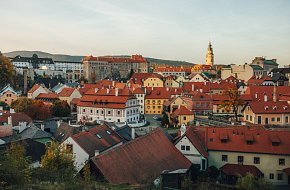
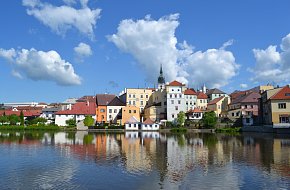
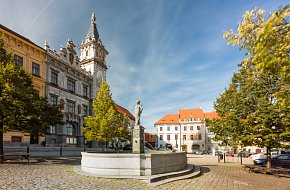
Some are proud, grand, and beautifully dressed, others have mended but clean clothes, and for others, attire is insignificant as they deal with more essential questions of their existence.
We found charming, happy, and worried towns.
The most charming ones are hidden among groves and fields, by ponds or in deep forests. Their inhabitants also have various natures: some came after World War II, others have lived modestly for generations, and some bear the painful history of the border zones.
But all of them are beautiful in their own way.
They are definitely worth visiting.
Bechyně, České Budějovice, Český Krumlov, Dačice
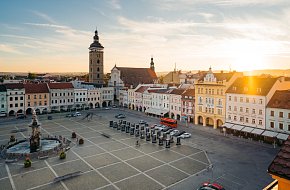
Who doesn't know the movie "The Weddings of Mr. Vok"? Did you know that there is a castle in Bechyně that stands on a narrow promontory? České Budějovice was founded in 1251 by Přemysl Otakar II. Near the square with Samson's Fountain stands the Black Tower with 225 steps, the Cathedral of St. Nicholas, and a number of Renaissance and Baroque houses with arcades, passages, and narrow streets leading in all directions. The first written mentions of the actual town date back to 1309 from a document by Henry I of Rožmberk. Under the rule of the Rožmberk family, both the town and the castle experienced their greatest prosperity. Did you know that Dačice has two castles? The Krajíř family first had the so-called Old Castle built here, which was completed in 1579.
Chelčice has a rich tradition of fruit tree cultivation. The dominant feature of the village is the originally Romanesque Church of St. Martin, rebuilt in the 14th century, which was also frequented by Petr of Chelčice. The coat of arms of the Lords of Hradec, a golden rose on a blue field, supplemented in 1483 by King Vladislav II's privilege with two golden lions and the initial W with a crown, is still part of the emblem of Jindřichův Hradec today. Another highlight of Jindřichův Hradec is the complex of the state castle and chateau, which is the third largest historical monument in the Czech Republic. The dominant feature of Netolice is the town hall from 1869, built on the foundations of several original medieval houses. The town museum, along with the information center, is housed in the most well-preserved Renaissance house on the square. The guard castle in Nové Hrady, standing on a promontory with a massive moat, has been managed by the National Heritage Institute since 2000.
In Písek you can find the oldest stone bridge in the Czech Republic, which is listed as a National Cultural Monument and is even older than the Charles Bridge in Prague. It was formerly also called the Old Bridge or the Deer Bridge, as the first to cross it was a deer.
The historic town of Prachatice, also known as the “Gateway to the Heart of the Bohemian Forest” or the “Pearl on the Golden Path,” was founded at the turn of the 13th and 14th centuries. In 1382, Prachatice gained the right to have a salt warehouse, and from then on, other towns had to buy salt from them, which brought great prosperity.
Slavonice lies on the Moravian side of the South Bohemian Region and is the westernmost town in the historical territory of Moravia. The town experienced its greatest development in the 16th century. The most valuable monuments from this period are the burgher houses with richly decorated façades, which, in addition to lozenge motifs, feature a large number of intricate figurative sgraffiti.
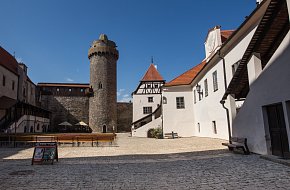
In Strakonice, an exceptional monument is the Strakonice Castle, remarkable both historically and architecturally. Little is known about the beginnings of the castle.
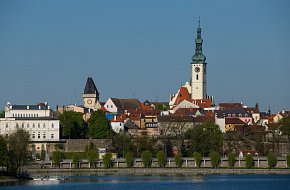
The town of Tábor was founded in an absolutely unique way: within just a few weeks, when Hussites from the surrounding area, mainly from Sezimovo Ústí, moved here. Immediately after its establishment, the town created its own army as well as both spiritual and secular administration.
Trhové Sviny was probably originally called Svinice. Since time immemorial, the town has been the trade centre of the southernmost part of South Bohemia and, as its name suggests, became famous especially for its markets.
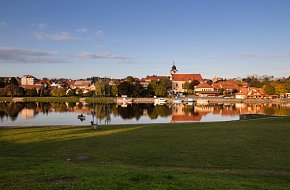
The town on the edge of the large Svět Pond (formerly called Nevděk) was, like other South Bohemian towns, influenced by prominent noble families who owned Třeboň. The site first had to be cleared and cultivated before a settlement could be established.
In the mid-13th century, Bishop Tobiáš of Bechyně built a guard castle in Týn to protect the ford and trade routes. A significant noble family connected with the town’s history is the Čabelický of Soutice, who held the estate as pledge holders from the second half of the 15th century until 1600.
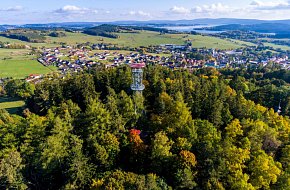
The name Winterberg (Winter Mountain) may originally have referred to a place where snow lay for a long time – winters here are indeed still quite long. The town was founded as a colonisation settlement, above which Purkart of Janovice built a castle between 1260 and 1263. In 1423, the Hussites burned down the settlement, and in 1479 King Vladislaus II Jagiellon elevated it to town status.
Volary is located in the southernmost tip of South Bohemia, in the southwest of the region, 16 km from Prachatice. Everywhere you go, you can sense its rich but also harsh history. Locals are said to have a distinctive character, being suspicious of new influences, reluctant to marry outside their territory, but historically very determined.
Unlike the lower, rear, or front villages in the area, Horní Planá is a real town – a centre and blend of nature, urban development, and historical ties to the entire Bohemian Forest region. The settlement was founded by the Cistercians from the Zlatá Koruna Monastery and was first mentioned in 1332 as “Planá under Vítkov Hill.”