

Sedláček Trail
The Sedláček Trail is a hiking route running along the Otava River from Písek to Zvíkov. The 25 km trail was built between 1924–1928 and is named after August Sedláček, a professor, historian, and passionate hiker.
Total length
25 km
Duration
One-way hike: 4:30 h
Terrain
Asphalt, gravel, forest and field paths
Difficulty level
Medium
Marking
Yes
Route description
The northern part was flooded by the Orlík Reservoir, so the trail has been rerouted higher above the valley. Today, most of the route follows the left bank (marked with a red tourist sign) and is also part of the European long-distance trail E10. Since 2006, the Sedláček Trail has been renovated as a modified 35 km cycling route (no. 1225) for mixed use by hikers and cyclists, with some sections paved. The route can be done as a round trip without repeating the same path.
Interesting places on the route
Písek – In Písek, you’ll find the oldest stone bridge in the Czech Republic, dating back to the 13th century — almost 100 years older than Prague’s Charles Bridge. You can also visit a unique technical museum located in a functioning hydroelectric power plant from the turn of the 19th and 20th centuries. Another interesting visit is the National Stud.
U Sulana – A popular spot easily reachable from the center, either on foot, by bike, or on rollerblades. There’s a tavern and playground here. Locals come here in the summer for chilled drinks and grilled mackerel in the evening.
Gas Pipeline Footbridge – Though no longer in use for its original purpose, the footbridge allows a dry crossing over the Otava River and offers pleasant views. If the Orlík Reservoir is full, the river here takes on a calm, lake-like appearance.
Jistec – A local part of the village Vráž, where only three permanent residents lived in 2011. There are several old cottages and farmsteads. Nearby are the Dědovice settlement and the Dědovické Stráně nature reserve, known for its rich flora. Roads lead to Jistec from both sides, as there used to be a ferry here and even plans for a bridge over the Otava.
Vráž – The village of Vráž is mainly known for its spa, located in a local chateau. The spa treats heart and musculoskeletal conditions. The entire village has a calm, spa-like atmosphere, and the local climate is unique due to a combination of water bodies and forests. You can enjoy regional specialties at the spa and stroll through the extensive park. In the nearby forests, you’ll find the so-called “Lakes of Love,” where the opera Rusalka was filmed.
Confluence of Lomnice and Skalice Rivers – Two substantial streams feed the Otava shortly before it joins the Vltava at Zvíkov. The surrounding nature resembles the wild landscapes of the Šumava mountains or alpine valleys, with numerous nature reserves nearby. There’s a beautiful view from the Krkavčí Skála viewpoint.
Štědronín – The original settlement dates back to the 16th century. After the Orlík Reservoir was filled, Štědronín became a popular holiday destination, as the Jitex Písek textile company built a recreation center here. Today, you’ll find both the original recreational buildings and newly renovated cozy guesthouses and apartments continuing the tradition of summer retreats. There’s also a well with drinking water. The area was used for filming the Czech movie Plavecký Mariáš (Swimming Whist).
Zvíkov Bridge – Technically, we should speak of the “Zvíkov twins” — two identical bridges, one spanning the Otava, the other the Vltava. These bridges replaced the original ferries that operated until the Orlík Reservoir was filled. The twin bridges were built using a patented Czechoslovak construction method called “balanced cantilever.”
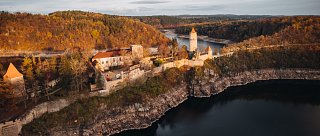
Zvíkov Castle – The Gothic Zvíkov Castle rises on a rocky promontory above the confluence of the Otava and Vltava rivers. It was founded by the Přemyslid dynasty in the first half of the 13th century as a royal castle and served as a military fortress during times of political instability. During the reign of Charles IV, it was even used as a temporary storage place for the Czech crown jewels. Today, it’s a popular tourist destination, and from here, you can také a sightseeing boat to Orlík Chateau. Zvíkovské Podhradí, the village near Zvíkov, is the main bus stop area. It has a renovated swimming pool, hotel, brewery, pub, and various accommodation options.
Return route
Saint Anne – A local part of the village Oslov, centered around a chapel of the same name. According to legend, the chapel was built on the site of an old hermitage — or, as another legend says, at the exit of a secret tunnel from Zvíkov Castle. Yet another tale claims there’s a hidden grave of an unknown man next to the altar.
Krkavčina – Krkavčina is a nature reserve protected for its relict pine forest and the presence of bearberry (Arctostaphylos uva-ursi). It was declared protected by the Czechoslovak Ministry of Culture on May 31, 1974. The 110–200-year-old stands resemble the original forest growing on the steep cliffs above the river. The Eurasian eagle-owl (Bubo bubo) regularly nests here. You can reach Krkavčina via the so-called “Partisan Trail” from Oslov. About 1.5 km south is another nature reserve, Výří Skály (Owl Cliffs), and across the river, the Dědovické Stráně reserve.
Tukleky – Northwest of the village, you can follow the green trail to the Výří Skály reserve near Oslov, and further north to Krkavčina. The cliffs above the reservoir guarantee stunning views.
Spolí – Originally a medieval village first mentioned in the early 13th century. Today, only one cottage and a small farm remain.
Louka – A picturesque village, home mainly to farmers and proud South Bohemians known as “furiants,” who také great pride in their homeland.

