

From Prachatice to Libín
Set off to the highest point above Prachatice.
The historic center of Prachatice is one of the best-preserved Renaissance sites in the country. Inside the city walls, with the most famous bastion Helvít, countless historical monuments have been preserved. That is why in 1981 it was declared a Municipal Heritage Reservation.
The most romantic entrance into this historic core is through the Lower Gate, also known as the Písek Gate, with remnants of artillery shelling – half-walled-in cannonballs. After entering through the gate, notice on the left the so-called Haydl House No. 29 with Renaissance sgraffiti. Just behind it stands the landmark of Prachatice – the Church of St. James from the 14th century, where 75 German citizens were burned in the sacristy during the Hussite wars. In the alley behind the church, on house No. 31, you can see the most beautiful sgraffito in Prachatice – a depiction of the Last Supper from 1563. On the main square (Velké náměstí), there are more houses adorned with sgraffiti – the Rumpál House No. 41, the Sittr House No. 13 (home to the local museum), and the Bozkovský House No. 45. At the top of the square stands the Old Town Hall from 1570–71, decorated by the painter Březnický. The New Town Hall dates from 1903. In the middle of the square stands a 16th-century fountain with a statue of Justice.
From the center of Prachatice, we follow the red tourist trail to the former town spa Svatá Markéta, which operated from 1783 to 1935. Treatments were performed using cold water following the methods of Priessnitz or Kneipp, targeting nervous or musculoskeletal disorders. Several spa buildings still stand today.
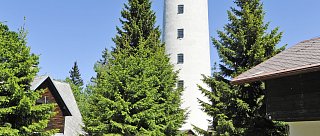
We continue on the red trail and, at the spot where it turns sharply to the right, we go straight ahead along the restored Stations of the Cross to the Chapel of St. Philip Neri. The chapel from 1803 replaced the original wooden one. Pilgrimages from Prachatice to the chapel and healing spring used to take place twice a year. We continue downhill and then gently uphill; after about a kilometer, we join the yellow tourist trail and proceed to the crossroads U Sedélka, where we turn right onto the blue trail towards the Libín hill (1096 m a.s.l.). There stands a 27-meter-high lookout tower, built by MTK in 1883 to commemorate the visit of Crown Prince Rudolf to Prachatice on July 16, 1871, and named “Crown Prince Rudolf’s Tower.” Today it is open year-round except Mondays, and from its viewing platform, one can see not only Prachatice but also much of the Šumava (Bohemian Forest), the Novohradské Mountains, the Blanský Forest with Mount Kleť, and the Brdy hills. In clear weather, especially in autumn, even the Alps can be seen.
Once you’ve soaked in the views of the lush Šumava forests, descend along the same blue-marked trail to Libínské Sedlo. Formerly known as Fefry, the village was first mentioned in 1351. The famous Golden Path once ran through here. A late Gothic church of St. Anne from the 16th century, baroquized in 1732, has been preserved here. The village features houses with half-hipped roofs, influenced by the Blata architectural style. From Libínské Sedlo, take the yellow tourist trail back to Prachatice. Along the way, you can notice terrain remains of the aforementioned Golden Path, which was used to transport salt from the Bavarian city of Passau to Prachatice.
Basic information:
Starting point: Prachatice
Route: Prachatice–Libín–Libínské Sedlo–Prachatice
Length: 14 km
Difficulty: higher
Access: on foot
Refreshments: Prachatice, Libín

