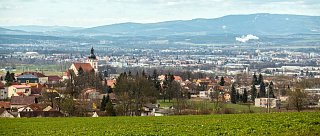


Through the České Budějovice Region near the Mining Town
Few people today would guess that silver was once mined in the České Budějovice area. Specifically, it was the small town of Rudolfov and its surroundings where silver mines were located. The route both starts and ends in this historic mining town.
Total length
21,5 km
Duration
6 hours
Terrain
Asphalt/pavement, hardened surface.
Recommended period for visiting
Year-round
Difficulty level
Low
Marking
Yes
Route description
The ideal starting point is the local chateau, from where you head slightly uphill and pass the Mining Museum on the right. After the museum, turn right to follow the yellow tourist trail and the local educational trail “Around the Mining Town.” You’ll pass by the Královský Pond and Jarval Pond. Continue to the crossroads with the red tourist trail near Mrhal Pond, where you turn left. You walk through the village of Jivno and continue along the red trail to the so-called Eternal Point (Locus Perennis) and on to the town of Lišov, where you can see the Horní Pond on the left — a great spot for a break or picnic.
The tourist trail continues to the Church of St. Wenceslas and the F. M. Čapek Museum, located in the Schwarzenberg Hospital. A little further, behind the local cinema, is Míru Square, where you’ll find another tourist signpost. From Lišov, také the blue trail, which leads all the way to Koníř Pond, suitable for swimming. Here, turn left onto the yellow trail, cross the road toward Hvozdec. Near the municipal office, you’ll find the Bozízovka distillery, where local products are available for tasting. From Hvozdec, return to the road and continue toward Zvíkov.
In Zvíkov, follow cycling route 1096, which leads back to Mrhal Pond, turning off before the village of Hlincová Hora. At the edge of the pond, you’ll meet the yellow tourist trail again, where you turn left and reconnect with the educational trail “Around the Mining Town.” You finish at the end of the educational trail, where you’ll find the charming Lustenek chateau on the right.
Interesting places on the route
Rudolfov
Rudolfov is a classic example of a spontaneous mining town. The first written record of silver mining in the area dates back to 1385. The most intense mining activity took place in the second half of the 16th century. At the time, Rudolfov ranked alongside Jáchymov and Kutná Hora as one of the most important mining centers in Bohemia. The main landmark is the massive Church of St. Vitus, built between 1554–1583 as a Protestant church. Another landmark is the former Mining Office building (now the town hall) with Renaissance decorations and a small tower. In the lower part of town stands the Renaissance-style chateau. Around the Královský Pond dam, you’ll find a burgher’s house and several picturesque small-town houses.
Mining Museum
The museum is housed in the Perkmistrovský House, which has been renovated and now serves both locals and visiting tourists. It includes a tourist information center, spaces for cultural events, and especially mining exhibitions. The exhibits are divided into sections: Beginnings of Mining in South Bohemia, Colonization of Rudolfov, Peak Period of Silver Mining, Mining Administration, Attempts to Revive Mining, and State Mining.
Lišov
Lišov was founded in the second half of the 13th century. The location was well chosen, as the ancient trade route between South Bohemia and South Moravia gained importance after the founding of České Budějovice in 1265. The commercial activity between Budějovice, Třeboň, and Jindřichův Hradec grew, which local craftsmen and merchants eagerly took advantage of. Lišov was also a major transport hub, with a direct road connection to Hluboká Castle.
Schwarzenberg Hospital
The hospital was founded on September 2, 1676, by Jan Adolf Schwarzenberg, who dedicated it to St. John the Baptist and St. Anthony of Padua. It was intended for retired servants of the noble family who spent their final years here. In the 1930s, Jan Schwarzenberg donated the hospital to the town of Lišov. Today, it houses the F. M. Čapek Museum, the Jan Rafael Schuster Exhibition Hall, and an art gallery.
Horní Pond
This pond on the edge of town is a pleasant spot for rest. You’ll find covered benches and several sculptures overlooking the pond.
Děkanský dvůr – Lustenek
Lustenek (Děkanský dvůr) is a Renaissance manor or chateau from the late 16th century, located near Rudolfov. It remains an example of Renaissance architecture, later modified in Baroque and Classicist styles. It served as an agricultural estate for the local deanery and as an occasional country residence for deans, hence the name “Dean’s Court.”
Mrhal Pond
This pond is one of the most charming recreational and fishing spots in the area. It offers great conditions for fishing year-round, governed by local regulations. The deepest point reaches about 15 meters.
Locus Perennis
The “Eternal Point” — one of seven basic elevation measurement points in the former Austro-Hungarian Empire. The local elevation is precisely 565.1483 meters above sea level (according to sea level in Trieste). The marker is covered by a pyramid with a Latin inscription and is often mistakenly thought to mark the center of Europe. Locus Perennis is protected as a significant technical monument.
Bozízovka (Hvozdec)
Local products from the family-owned distillery and fruit brandy producer in Hvozdec come from the center of the village, just behind the municipal office. Next to the distillery, you’ll find standing stones (menhirs) that may give you strength for the next leg of your journey.
Koníř Pond
Koníř Pond is an ideal place to cool off. In the past, the town of Lišov renovated the area — improved beaches and shores, changing rooms, fire pits, and wooden gazebos are available.
Zvíkov Fortress
This late Gothic fortress from 1406 has been protected as a cultural monument of the Czech Republic since 1963. Originally a two-story structure, today it is a one-story stone building — one of the few of its kind so well preserved in Bohemia. Currently, the fortress is privately owned and not open to the public

