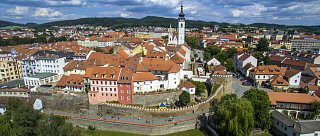


Písek – A Royal Town on the Otava River
 A settlement founded on gold-bearing sandbanks grew into a village, then a royal court, and finally into a town with a castle founded by Přemysl Otakar II.
At the end of the 13th century a mint was established in Písek, which was later moved to Kutná Hora. During the reign of Charles IV, a saltworks and the largest grain warehouse in Bohemia were established in the town.
During the Hussite Wars, Písek supported the Hussites and was probably the first Czech town to house the famous Hussite vats, where the inhabitants gave their valuables.
The town reached its greatest prosperity in the 16th century, when it was given a royal castle and a number of Renaissance townhouses were built.
The jewel is the oldest stone bridge in the Czech Republic, which is registered as a National Cultural Monument and is even older than Charles Bridge in Prague. It was also formerly called the Old or Deer Bridge, as a deer unexpectedly crossed it first.
Sisk has two parallel squares and the centre acts as one compact unit. On the lower square (the Great Square) stands the large town hall building with two towers. The town hall is baroque, built between 1740 and 1767. There is a passageway in the front which leads to the castle courtyard. The Royal Castle originally had four wings, but it burned down in 1510 and parts of the buildings were replaced by new ones. The west wing houses the Prácheň Museum, which was awarded the honorary prize of "European Museum of the Year" by the Council of Europe in 1996. In the immediate vicinity is the Malt House, currently the largest children's and family playroom in Europe.
A large number of houses in the historic part of the town were modernly rebuilt in the 19th and 20th centuries and decorated with Empire or historicist facades. On the Otava Hotel, it is possible to see paintings based on the cardboard paintings of Mikuláš Alš.
In addition, the mosaic of the city's architecture includes villas designed by architects Janák, Jurkovič and Koula, and a modern design footbridge by architect and Písek native Josef Pleskot, which arches over the Otava River at St. Wenceslas and serves pedestrians and tourists.
Sand is the lifeblood of Písek even today, which is why you can see sculptures and works of art made of sand along the river.Since 2007, giant sculptures made of this material have been created every year on the embankment next to the Stone Bridge. The open-air gallery is then freely accessible usually until autumn, depending on the condition of the sculptures.
Additional information
Families and personalities
- Fráňa Šrámek (1877-1952) - is almost synonymous with the town, he studied at the local gymnasium and lived near the bridge and the river in the house U Koulí. He left the town in 1894 and never came back, refusing invitations or responding to them with poems.
- Adolf Heyduk (1835-1923) - lived here from 1860 as a teacher of drawing and draughtsmanship. At a time when his fame as a writer was slowly fading, he liked to go to local wine bars and to apothecaries for herbal liqueurs, and believing that everyone was pleased with his visit, he did not pay for the expense. Today, it is possible to visit the poet's Art Nouveau apartment.
- Katerina Neumannová (1973) - Olympic winner in cross-country skiing at the 2006 Winter Olympics in Turin, sports official. She gained a love for sports in her childhood, her mother taught physical education and biology in Písek.
Our tip
In the chapter "Švejk's Budějovice anabasis" the main character of the novel sets out on foot from Tábor to České Budějovice, and his journey ends in Písek. Try to complete his journey according to the booklet, which is available to tourists in the city.
Do you know that...
...Písek became the first place in Bohemia to get permanent public electric lighting? On 23 June 1887 František Křižík illuminated the town centre and the councillors subsequently bought this innovation from him?

