

Across the Region Beneath Javorník
Visit Klostermann’s legacy.
The starting point of this hiking trip is Vacov, first mentioned in 1352. The municipality consists of three parts: Vacov, Vlkonice and Miřetice. Its dominant feature is the Church of St. Nicholas, built between 1888 and 1890 to the design of Schwarzenberg architect Jan Sedláček, with Jan Štěrbík from Vimperk as the builder.
Numerous tombstones have been preserved in the church, and a valuable item is the bell made by master Brikcí of Týnberk from 1588. The bell bears an inscription dedicated by donor Václav Koc of Dobrš. Around the church, one can find summer mushrooms known as koloděj. Below the church is a niche chapel of St. John of Nepomuk from the 17th century.
From Vacov, the route leads in the direction of Sušice to Vrbice. Here you’ll see a chapel from 1949 and several timbered houses, particularly the striking one to the left behind the chapel. Turn left, pass through a cottage area, and join the blue tourist trail. On the left lies the Rohanov swimming area, where you can stop to bathe and refresh.
Continue through the settlement of Milíkov, still following the blue trail to Javorník. As you enter the village, you’re welcomed by a statue of Karel Klostermann, who helped establish the lookout tower — our destination today. But let’s not get ahead of ourselves.
Javorník is a popular tourist spot — thanks in part to Rudolf Beran, a Member of Parliament and Prime Minister of the First Republic and later the Protectorate. He was responsible for building the Švehla chalet (now a sanatorium), paving the main street, and electrifying the village.
You’ll find several restaurants for refreshment in Javorník. The village center holds a heritage-protected rural homestead, house no. 29. From there, head alongside the forest and ski lift to the top of Javorník (1,065 m above sea level). Halfway up, stop at the heritage-protected rotunda of St. Anthony of Padua, built in 1939 and solemnly consecrated on 4 August 1940.
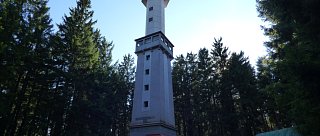
A beautiful view from the rotunda spurs you on to the lookout tower, where the panorama is even more breathtaking. The tower was built only in 1938, though the preparatory committee led by Klostermann was active as early as 1914. World War I and then a lack of funds delayed construction. Work began on 21 June 1938 and ended on 31 August that year.
It was designed by architect Karel Houra. On 27 stone blocks are engraved the names of those who made the tower possible. An extension was completed in 2003.
Today, the tower has 197 steps, stands 39 meters tall, and its viewing platform sits 30 meters up. In clear weather, you can see not only Šumava peaks like Großer Arber or Rachel, but even the Alps.
From the tower, descend back into the village and follow the yellow tourist trail to Úbislav. By the bridge over Horský stream stands a so-called “Bavarian Rooster Cross” — a folk monument featuring the Instruments of the Passion and various tools, brought from Bavaria in the 19th century by local farmer and hauler Fr. Štoural, who had it repaired and erected at his own expense.
Past the village stands a 350-year-old beech tree. In 1971, its circumference at 130 cm above ground was 397 cm; it was 18 meters tall with a crown diameter of 20 meters.
Continue by road to Benešova Hora, a village known for its architecture influenced by South Bohemian rural Baroque. House no. 32 is over 200 years old. In the village stands a lime tree more than 360 years old, with a trunk circumference of 575 cm. Walk via Peckov to return to Vacov.
Basic Information:
- Starting point: Vacov
- Route: Vacov–Vrbice–Milíkov–Javorník–Úbislav–Benešova Hora–Peckov–Vacov
- Length: approx. 15 km
- Difficulty: medium
- Access: on foot, or by bike for experienced riders
- Refreshments: Vacov, Rohanov, Javorník, Benešova Hora

