

Walking Circuit through Husinec
Take a stroll through Husinec, the birthplace of Master Jan Hus.
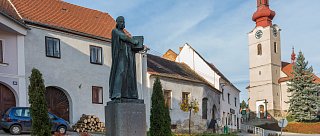
Husinec is a small town located in the Blanice Valley. Settlement in this area is connected to gold panning, and remnants of this activity – tailings heaps called “sejpy” – can still be seen along the Blanice River. The first written mention of Husinec is from 1359, when it was elevated to town status. In 1455, Husinec belonged to the Rosenbergs, later to the Kolowrats and Eggenbergs, and since 1848, it has been an independent market town. Its most famous native is, of course, Master Jan Hus. Today, his birthplace, house No. 36, is open to the public – it has been accessible since 1873. Above the entrance is a medallion by Bohuslav Schnirch. The house also includes a memorial hall dedicated to another prominent native, painter Josef Krejsa (1896–1941). You can see his work when you walk down from Hus’s house to Prokop Square. On the left, the sgraffito decoration of the so-called Fidler House, No. 42, stands out. In 1937–38, Krejsa depicted historical Czech figures and coats of arms of South Bohemian noble families within decorative panels. On his wife's house, he painted Saints Wenceslas, George, and Martin. As you continue along the elongated square, you’ll notice the statue of Jan Hus from 1958 by sculptor Karel Lidický.
Just a few dozen meters farther is the Church of the Exaltation of the Holy Cross, which has Gothic foundations, though its current appearance dates from the period after a fire in 1802. Husinec also has a cemetery church dedicated to Saints Cyril and Methodius. Here, too, you’ll find frescoes by Josef Krejsa. In the cemetery, the tomb of the Rys brothers – pilots who tragically died on the eve of World War II – draws attention. Their grave is marked with a wooden airplane propeller. Painter Cyril Chramosta is also buried here. From the cemetery, walk back toward the church and down to the Blanice River. Near the bridge built in 2002, there is a Baroque statue of St. John of Nepomuk from the 18th century. After the bridge, turn right and walk through the park along the river, over a new footbridge, and around the rocky outcrop where a small castle once stood. Tunnels once led from here to the town's earliest buildings. Since it’s daytime, you needn’t fear the White Lady, who supposedly waits here at night to be freed – but legend says her curse will last until the ninth generation. Continue to the main road, turn right, and complete the loop by returning to Prokop Square.
By Bike to the Husinec Dam
Leave town heading toward Vimperk, and at the end of Husinec, turn left. After about 3 km, you’ll reach the Husinec Dam (constructed 1934–1938). The Blanice River frequently caused floods. Plans for the dam began as early as 1910, with a proposed location above Záblatí. However, World War I halted the idea. Construction was delayed repeatedly, and only after a major flood in 1932 was it approved. Work began in 1934 and was completed in 1938. The dam is 31 meters high and 215 meters long at the crest. The flooded area covers around 760,000 m² and submerged, among other things, a former shooting range and ended the annual floating of firewood from the Šumava forests to Vodňany.
Follow the yellow trail along the Blanice River to Hus Rock (Husova skalka), where, according to legend, Master Jan Hus used to rest. The rock is said to bear his profile. Below the rock was once a weir where children used to swim. Pass through the park and you’re back in Husinec.
Basic Information:
Starting point: Husinec
Route: Husinec Circuit
Length: 3 km / or 5 km
Difficulty: moderate
Access: on foot or by bike
Refreshments: Husinec

