

Discovering the Sights of Vlachovo Březí
See the 260-year-old sycamore known as “David's Tree”.
The village of Březí was probably founded at the beginning of the 13th century, with its foundation being a fortress. The nobles who held the fortress bore the epithet “of Březí.” The most famous bearer of this title was Oldřich Vlach of Březí from the Malovec family, after whom the picturesque town is still named today. Already in 1538, Březí was promoted to a market town and was granted a grey billy goat on a blue shield as its coat of arms. In the mid-18th century, the château was rebuilt in the Baroque style. In 1858, it became the property of the Herberstein family, who owned it until 1945. Meanwhile, in 1868, Emperor Franz Joseph I elevated Vlachovo Březí to the status of a town.
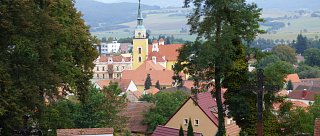
Today the château is owned by the municipality and is not open to the public. It has an L-shaped ground plan. The ground floor is older with barrel vaults, while the newer first floor is Baroque and decorated with stucco ceilings. The renowned writer Jan Neruda used to visit the château to see Anička Tichá, the daughter of the local estate manager. A commemorative plaque on the château's façade still reminds us of this. The dominant feature of the town square is the Church of the Annunciation of the Virgin Mary, built in the mid-17th century. The church was erected by the then owner of the estate, Count Karel Leopold of Millesimo. In front of the church stands a statue of the Immaculata, the Immaculate Virgin Mary, from 1774. A peculiar custom was the throwing of a live billy goat from the church tower on the feast of St. James. Decorated and cheered by the townspeople, the goat was thrown down by butchers and quickly slaughtered below. Its blood was then sold as a remedy for various ailments. This custom lasted until 1859.
Opposite the church stands a coaching inn from the 17th century, house no. 189. A few steps away is a plaque commemorating folk builder Jakub Bursa, whose work can be admired when you head from the square towards Volyně, where in a bend stands the former blacksmith's house no. 21. It was built in the so-called rural Baroque style by this master mason. We return to Svobody Square and continue towards the cemetery. Just before it, to the right, stands a World War I memorial created by stonemason Křivánek in 1926. Above the cemetery, on a hill, is the Chapel of the Holy Spirit, hidden in the shade of large lime trees and accessible via a Way of the Cross. The original chapel was built in 1702 by Prince Dietrichstein, and the first decoration was done by local painter Boška. According to legend, there was first a painting and only later a chapel. The painting of the Virgin Mary was donated by Pope Clement IX to the Chapel of the Holy Spirit in Hradec Králové. A man named Foltýn was unable to carry it further and left it in Březí, where a wooden, and later a brick, chapel was built for it.
From the Chapel of the Holy Spirit, follow the Way of the Cross past the former Schmied Brewery and arrive at the Jewish cemetery from the 17th century. There are about 170 tombstones here, as the Jewish community was quite large and even had its own synagogue in Březí. Of particular note is the sycamore tree known as David's Tree, considered by some to be the most beautiful in the country. The trunk splits into seven main branches at a height of about two meters, resembling a Jewish menorah. The tree is estimated to be 260 years old.
From there, return to the square past another former brewery, this one the Count's Herberstein Brewery, which operated until 1924. The building impresses with its size, Baroque gables, and a façade decorated with red rectangular shapes. Storks nest on its chimney. During the summer, visitors can cool off at the nearby natural swimming pool on the way to Libotyně.
Basic information:
Starting point: Vlachovo Březí
Route: surroundings of Vlachovo Březí
Length: approx. 2.5 km
Difficulty: moderate
Access: on foot
Refreshments: Vlachovo Březí

