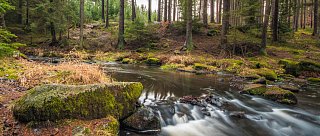


From Vitorazsko to Chlum Castle
The route leads through the peaceful landscape of Vitorazsko and the pristine Třeboň nature, through Třeboň forests, along the Lužnice River, local sandpits, and ponds.
Total length
16.5 km
Duration
4 hours
Terrain
Mostly paved asphalt road
Difficulty level
Easy route, mostly flat
Marking
yes
Route description
The starting point is a bus stop located on the educational trail Memories of Vitorazsko. This historic and educational trail guides visitors through the wild and mysterious border area. For a while, we leave this trail following the yellow tourist mark to the right towards the impressively wild Dračice River, which flows right through Františkov. We cross the river on a bridge, then leave the yellow trail and continue straight on the road. After about 300 meters, we reach a crossroads where we turn right. Here you can také your first break and explore the beauty of the Pískovna u Dračice nature reserve. We continue past the settlement Paris to a refreshment stand—Ubytovna U Jezera (2.4 km). At this point, we rejoin the Memories of Vitorazsko educational trail, which turns right just behind the refreshment stand. Following this trail, we reach another district of Suchdol nad Lužnicí called Klikov (1.1 km), where we cross the Dračice River again. The first turn in Klikov is to the left, and after about 200 meters, we turn left onto a forest path that will také us for the next 4.5 km through the pristine Třeboň nature near the Lužnice River, the Czech sandpits, and the nature reserve “Na Ivance.” After 4.5 km, we turn right toward cycle route 1010 Lužnická (60 m), which is also marked with a blue-red tourist sign. After this distance, we turn left. After about 500 meters, we cross a busier road back into the Třeboň forests heading toward Lutová following the signs on the asphalt road. Here we connect to the Around Třeboň educational trail, which leads us along the Kukla, Nový, and Starý Kanclíř ponds to the crossroads with the Mikuláš Ruthard educational trail (2.4 km). Following the Mikuláš Ruthard trail, we continue through the forest to Chlum u Třeboně (3.3 km – the town square). At the square, you will find the dominant landmark—the Church of the Assumption of the Virgin Mary. About 400 meters downhill at the dam of Hejtman Pond is the local castle, which unfortunately is not open to the public at present. However, you can enjoy the castle garden, rest after the long walk, or refresh yourself nearby.
Interesting places on the route
Vitorazsko – Vitorazsko (German: Weitraer Gebiet) is an area on the border of South Bohemia’s Novohradsko and Třeboň regions and Lower Austria’s Waldviertel. Since July 31, 1920, it has been divided between former Czechoslovakia and Austria. The original center was the Lower Austrian town of Weitra (called Vitoraz in Czech), from which the name derives. Today, the centers are České Velenice on the Czech side and Gmünd on the Austrian side. The landscape is enchanting and sparsely populated. Vitorazsko hosts many stone formations of various sizes and several abandoned villages due to several expulsions of locals (Najdorf, Kunšach, Rybné, Krabonoš, Nová Ves, Blata). For example, visitors to the settlement Nový York can get a commemorative stamp in their tourist diaries.
Dračice River – This small river cuts a deep gorge through wooded areas along the state border, in places closed to the public since the end of World War II. The romantic, forested, rapid-filled valley of the wild Dračice River is a rare example of nature little affected by human activity. Access to its valley is possible via the red trail from České Velenice to Chlum u Třeboně between Františkov (a village about 3 km east of Suchdol) and a bridge over the Dračice below Kolíbačný Hill (492 m a.s.l.). The upper protected part of the river is not yet accessible by tourist trails. A road from Suchdol nad Lužnicí runs along the Dračice to below Kolíbačný Hill.
Around the World in Vitorazsko – Tourists don’t need to fly anywhere for a world tour—just visit Suchdol nad Lužnicí. There are localities named Venice, Mexico, America, Big and Little London, Bosnia, New York, and Paris. Several versions explain how these names originated: people named them after cities they had traveled to for work; or as a kind of gratitude to western powers for annexing Vitorazsko; or most likely, the authorities arbitrarily assigned the names as the area was settled. No signs mark the settlements, but just turn off the main road and you’ll know you’re there.
Suchdol Sandpits – Large-scale sand mining began here as early as 1966. After the mining stopped, the pits naturally filled with water, creating large lakes offering great opportunities for sunbathing and swimming. Thanks to the large surface and beaches, everyone can find their perfect spot.
Lutová – Village Heritage Zone – Lutová is one of the oldest villages in the Třeboň region. It is mentioned in documents from the 14th century, when a manor house of the Landštejn lords stood here. Later it belonged to the Rožmberk family and from 1577 to the Chlum estate. Since 1990, it has been a protected village heritage zone. Since the late 18th century, timber cottages have been rebuilt into brick homesteads, usually keeping the original layout. The main house faced the street or village square and was connected by a wall and gate to the granary. Along with the barn behind the courtyard, they formed a closed square homestead. Compared to wealthier Blata estates, these were simpler buildings with triangular gables featuring simpler stucco decoration.
Chlum Pond Systém – This systém consists of ponds named Podsedek, Starý Hospodář, Žofinka, Výtopa, and others. Protected areas include the Staré Jezero Nature Reserve and the Vizír National Natural Monument. Nearby is also a sport fishing area at Nový Kanclíř Pond.
Church of the Assumption of the Virgin Mary in Chlum u Třeboně – This pilgrimage church stands on a hill in the village square and is a prominent landmark. Built between 1737 and 1745 by Count Jan František of Fünfkirchen, owner of the Chlum estate, he built it in gratitude to the Virgin Mary for saving his life. The church complex includes a Stations of the Cross and many saint statues around it. Inside, you can see beautiful Baroque decorations and several interesting frescoes.
Chlum u Třeboně Castle – A Neo-Baroque castle built in 1710, located near the dam of Hejtman Pond. It gained its current appearance after modifications at the end of the 19th and beginning of the 20th centuries. Surrounded by a castle park with many exotic trees, shrubs, and sculptures from the 18th and 19th centuries. The castle is currently privately owned and not open to the public, but the park is freely accessible.

