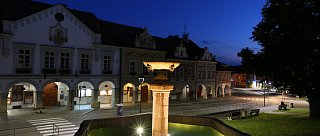


Trhové Sviny Urban Heritage Zone
The history of Trhové Sviny dates back to the mid-13th century
The history of Trhové Sviny dates back to the mid-13th century, when a settlement was founded at the confluence of the Svinenský and Farský streams along an old trade route from Vitorazsko to Bohemia. Over time, it became a major trading center in the region. Its rich history is still visible in many preserved landmarks, and the town has been declared an urban heritage zone.
At the heart of this zone is the town square with its town hall, surrounded by burgher houses connected by arcades. A unique feature is that the square is sloped – the southern side with the town hall is several meters lower than the northern side. Climbing past the hexagonal stone fountain from 1864 offers a striking view of the richly decorated town hall gable at eye level.
Trhové Sviny lies where the flat Třeboň Basin begins to rise into the hills leading toward the Bohemian Forest. It has always been a regional trade hub, as its name (“market town”) suggests. Well into the 1940s, it was famous for its livestock markets. Trade traditionally connected the area with Upper and Lower Austria.
Notable natives include Dr. Emil Hácha, president of Czechoslovakia in 1938–1939 and head of state from 1939–1945, and composer Karel Valdauf, in whose honor an international brass music festival is held.
The town is a starting point for hiking in the Slepice Mountains, just 10 km away. Visitors can enjoy hiking, cycling, sports, swimming, and accommodation in town.
Since 2003, Trhové Sviny has held extended municipal authority (level III) and serves as a regional center for employment, education, culture, tourism, and politics.

